
Thoughts on the Week

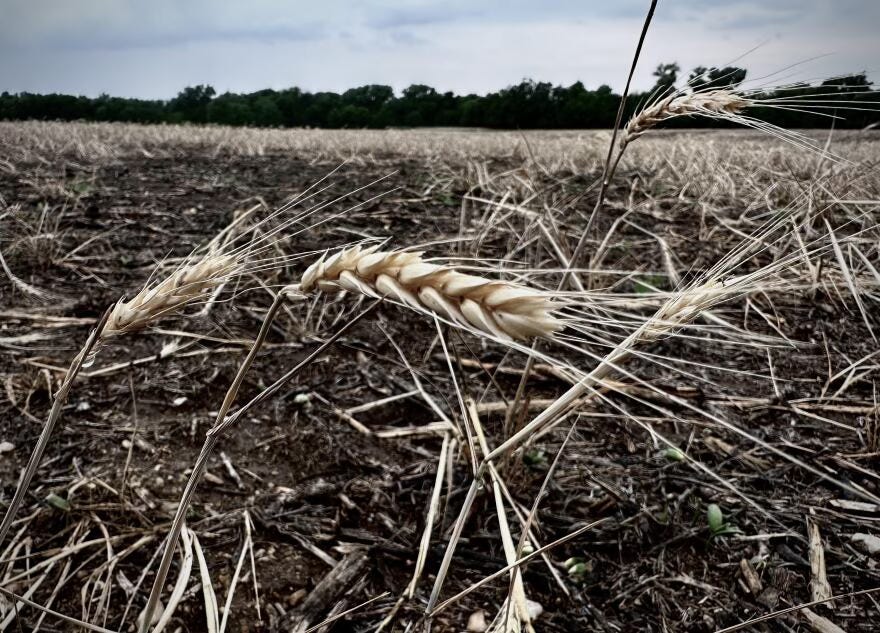
When you’ve been following and assembling collapse news for as long as I have, certain themes emerge, such as pending bad harvests and food shortages. Many people respond to such observations with finger-circles-at-the-temples and sky-is-falling mockery. It’s easy to see why. I’m 76 and have never had to worry about finding or affording food throughout my life. Food shortages have not been a factor for the great majority of Americans during my lifetime. Yet I don’t believe it’s too Henny-Penny-ish to observe that the days of shortages are fast approaching.
You will have observed the escalating cost of beef. Beef prices have surged to record highs over the past two years, with average ground beef hitting $6.75 per pound and premium beef steaks reaching around $12.80 per pound. These elevated prices are primarily driven by a 75-year low in cattle inventory due to prolonged droughts and rising operational costs for ranchers. The trends behind these price spikes are not abating anytime soon, nor is the American consumer’s appetite for beef.... It’s what’s for dinner, after all. (Which is why I often say that all speech is marketing.)
The American way of life has been based, in large measure, on cheap, abundant food. But inflation is coming for your loaf of bread. Due to severe drought in the Southern Plains, the USDA projects the 2026/27 U.S. wheat crop at 1.56 billion bushels, the smallest harvest in 54 years. A tighter supply outlook has driven the average U.S. farm price up to $6.00–$6.50 per bushel, while U.S. exports are forecast to drop to 775 million bushels as higher prices make domestic grain less competitive globally. Expect higher prices in the bread aisle next year.
And this is how collapse works. While billionaires worry about “the event” and engage consultants like Douglas Rushkoff to help them suss out how to keep their bodyguards from murdering them in their sleep, the truth is that collapse is a slow strangulation of your wallet. We’ve been living through escalating general inflation thanks to illegal tariffs and contrived spot shortages (and thank god that corporations collect the refunds, the better to goose those all-important stock valuations). Don’t be surprised if your grocery bill continues to increase.
If you believe, as I do, that we’re already living through collapse and that the signs and portents we see each week are just various threads of the post-industrial society popping, you might as well take it seriously and live your life consistent with that belief. One of my favorite writers is Jessica Wildfire, a former university professor who walks the walk as she talks the talk. Rather than wringing her hands, she is serious about acquiring skills needed to live in a world where the lights don’t come on, and the water doesn’t flow from the tap. She’s generous in sharing what she has learned and has written numerous articles about how she and her family have stopped prepping. She’s not preparing for dystopia and disasters. She’s living in them: We’ve Stopped Prepping. Here’s Why.
Perhaps you’ve heard William Gibson’s expression, “The future is already here, it’s just unevenly distributed.” Margi Prideaux, another writer who walks the talk, applies that to collapse: “Most still experience climate breakdown as anticipation—abstract, distant, safely unreal. But millions are already living it as memory: heat, fire, flood, loss, and aftermath etched into nervous systems and daily life. They live with climate chaos fingerprints already pressed into their bodies and their memories.” Her Substack is called Radically Local: CLIMATE CHAOS ARRIVES TWICE.
Sarah Connor believes, as I do, that “collapse of our industrial civilization is already underway, manifesting as a slow, agonizing process of structural decay, economic exhaustion, and ecological overshoot. Second, this descent is terminal. We have permanently exhausted the physical prerequisites for any future technological reboot.” In a recent article, she notes: “The over-reliance on flawed mathematical models built on historical data is ultimately a failure of imagination.” Because, as she describes, “ten sigma events,” or extreme events, occur with regularity and carry devastating consequences. Our MBAs think they can manage risk, and their models work within established, previously observed limits. But the outliers, like climate collapse? Why we’re blind to civilizational collapse, and why we fail to act when we see it.
I generally avoid electoral politics as a topic because other voices cover it better, with far more expertise and vastly greater reach. Graham Platner dropped out of the US Senate race in Maine due to accusations of rape. As someone firmly in the “me too” camp, my default position is to believe the woman. Yet there’s a certain amount of this story that stinks to high heaven. There’s no doubt that Platner was a flawed candidate. Yet both MAGA, AIPAC, and the Democratic establishment had been gunning for him, and they got him. Platner was flawed; the machine wanted him taken out. Both things can be true at once.
The Establishment Machine Got Platner, Will It Override the Voters Too?
Also see Thomas Neuberger’s nuanced account of the candidate, his accusers, and the political operatives who served up an irresistible story for Politico. As Neuberger says, “This story is bad for everyone trapped inside it.” The Graham Platner Affair
More soon.
May I add Ben Green's Substack "The Book of the Barracks", https://thebarracks.substack.com/. He started in 2021 to share his 10 year plan to build a post-climate change, self-sufficient, vegan community, and hasn't missed a week yet, as far as I can tell. He bought some army barracks and the land in between in former East Germany, growing all of his food and that for three rescued pigs, adding greenhouses, fruit trees, growing grains, beans, potatoes, tons of vegetables, and sharing how to do it. He's the most impressive post-collaps survivor I know.
Nice piece! climate change is real and is here. It is impacting crops and hunger around the world. 2 BILLION people are food insecure. Climate change creeps in and impacts food production through dozens of mechanisms. https://markroberts995.substack.com/p/fields-of-ash?r=1mi3pt&utm_campaign=post-expanded-share&utm_medium=web